In January, 2012, Disney blogs, discussion boards, and Twitter feeds lit up with news of President Barack Obama’s upcoming one-day visit to Walt Disney World. On the docket was a speech on tourism, to be given in front of Cinderella Castle to a small group of hand-selected guests. The visit necessitated not only the partial shutdown of Main Street, USA at the Magic Kingdom, but major resort-wide disruptions to WDW transportation. Public reactions ranged from indifference to mild annoyance to all-out anger; while some WDW guests dreaded the interruptions a presidential visit might bring to their Florida vacations, others protested the visit on more philosophical grounds.
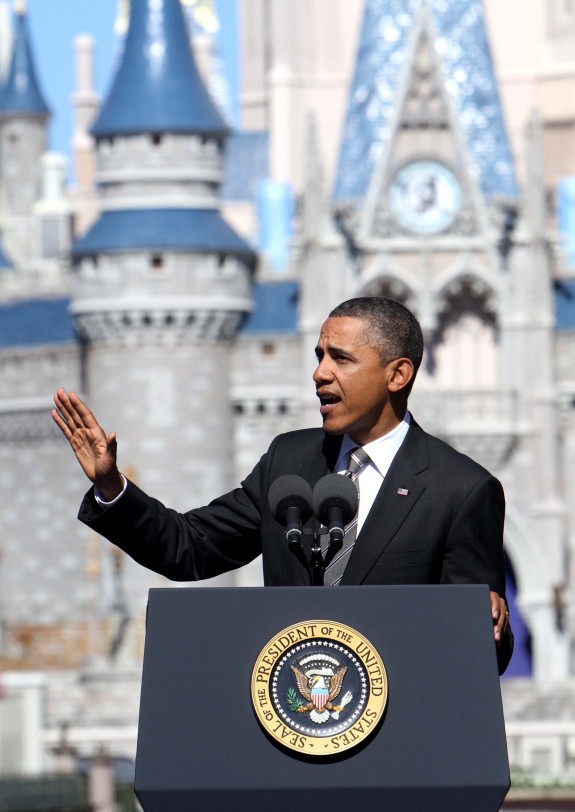
President Obama speaks at the Magic Kingdom in January, 2012. Photo (c) Orlando Sentinel.
This is an outcry heard from time to time: Disney is a place of magic and imagination, and because of this, the argument goes, Disney should by definition be apolitical. Lost in this argument is the reality most parkgoers (myself included) don’t want to think about once they pass underneath the WDW gates. Disney is not just a destination but a corporation, always backing a political dog in whatever fight might be going on in Washington, D.C., or in Florida, or in Anaheim. (Just this week the New York Times published an article about major protests raging just outside of Disneyland’s gates, and shrewdly points out the role Disney itself has played in local politics in Anaheim.) Further, Walt Disney imbued his movies– and eventually Disneyland itself – with values stemming directly from his political beliefs, which in turn were influenced heavily by the anxieties of postwar life. To say that Walt Disney World is or ever was apolitical is to overlook the longstanding symbiotic relationship between the Walt Disney Company and the federal government. In this context, Obama’s January visit becomes not an anomaly, but one in a series of official visits dating back to the 1950s. Today, a look back at the origins of this relationship.
During the Cold War, Disneyland provided great social and cultural guidance to help Americans reject the seemingly sinister influence of Communism. Through its careful design and painstakingly coordinated activities and attractions, Disneyland was tantamount to all that was good about American society – the prioritization of family; the importance of capitalism and consumerism; the celebration of national heritage. This was not accidental; Walt himself held a vehement belief that Disneyland should be a beacon of hope in the political fight against Communism, a place where not only family life, but all great American ideals – patriotism, capitalism, freedom, and democratic principles – would shine in stark contrast to the dark specter of foreign threats. Proclamations of the sanctity of American ideas and principles were particularly evident even on the opening day of the park. Walt Disney biographer Steven Watts describes the first events at Disneyland on July 17, 1955:
On a warm July afternoon, Walt and the assembled dignitaries launched this unique undertaking by reciting the pledge of allegiance, raising the American flag, leading the crowd in the singing of the national anthem, and bowing their heads as a Protestant minister invoked the Almighty’s blessing. In his speech, Goodwin Knight, the governor of California, informed listeners that it had been ‘all built by American labor and American capital, under the belief that this is a God-fearing and God-loving country.’ After this display of patriotic rhetoric, air force jet fighters flew overhead as a Marine Corps contingent led a joyful parade down Main Street, USA.[1]
On the very first day that Disneyland was transformed from an architectural blueprint into a living, breathing theme park, it was made clear that Disneyland was intended not only for fun and enjoyment, but for the uplifting of the American state as well.
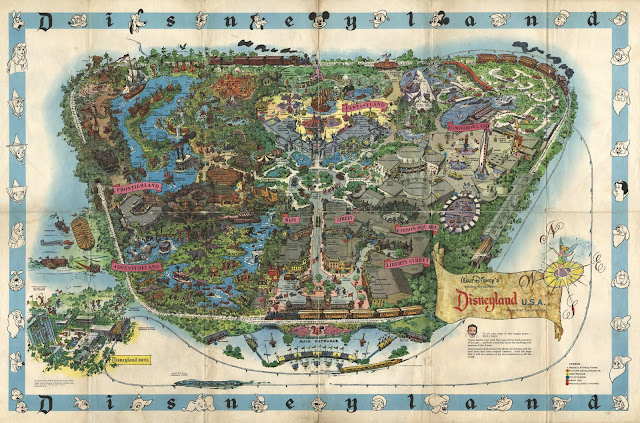
1961 map of Disneyland. Image (c) Disney History Institute,
Heralding the best of America curiously left out any discussion of the present. Allegiance to the United States, to American ideals, and to anti-communism was demonstrated in Disneyland through the heralding of the past and future, but not of the present day. Disneyland was not unique in this; historians have noted that the forging of American identity in the Cold War involved a complex blending of the nation’s heritage and its promise for the future.[2] The themed areas of Disneyland offered many opportunities to reflect on the past and to imagine a bright future, but no area was themed to represent present-day America. Beyond the idealized Main Street of America’s past, Frontierland celebrated the great American expansion to the west and dominance over the land; Adventureland demonstrated American mastery of “foreign” and “savage” lands; in Tomorrowland, visitors could glimpse advances in American technology and progress and learn about corporate innovations, space flight, and scientific discovery. By leaving the present at the ticket turnstiles, the ambiguities of war, cultural anxieties, and pressing social issues could be avoided,
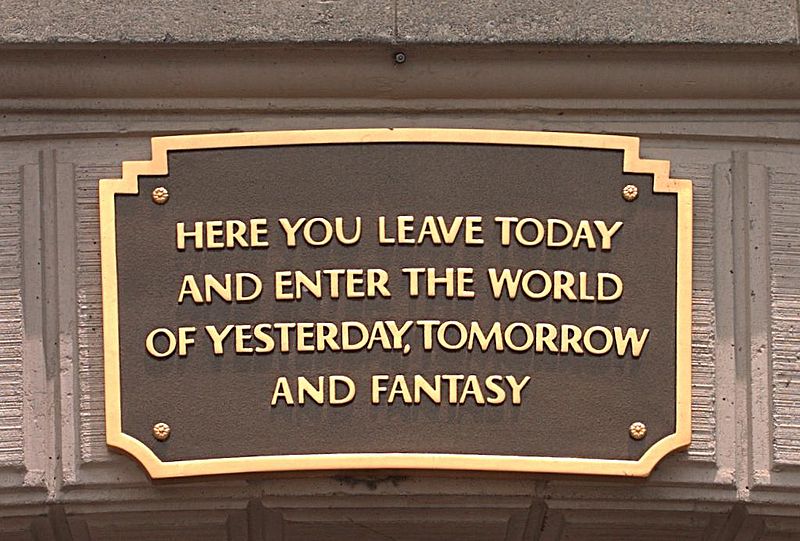 replaced instead by the celebration of American greatness both past and future. Ten years after the opening of Disneyland, the New York Times reported that the themed “lands” of Disneyland “represent the past, the future, and the timeless world of our fantasies. The present has no place in Disneyland.”[3] Even today, a plaque at the entrance to Disneyland reads “Here you leave today and enter the world of yesterday, tomorrow, and fantasy.”[4]
While the themed lands, attractions, and experiences at Disneyland did not offer guests the chance to interact with the present, Disneyland nevertheless played a role in the day’s political events. By inviting – or denying – world leaders to experience the greatness of America through a day-trip to Disneyland, the United States government deployed Disneyland as a political tool. Throughout the first several years of the Cold War, visitors to Disneyland included 11 kings and queens, 23 presidents and other heads of state, and 25 princes and princesses. In 1965, the New York Times noted that the demand for VIP entry to Disneyland was so great that Disneyland employed a full-time liaison to work with the protocol desk at the United States State Department. Further, the federal government actively encouraged leaders from third-world nations – Bolivia, Ecuador, and Haiti, for example – to visit Disneyland as a means of introducing the “greatness” of America in a contained, palatable, and entertaining experience. An equal, perhaps larger number of world leaders requested a visit to Disneyland while visiting the United States, elevating Disneyland to the status of a national icon, similar to a visit to the National Mall in Washington or the Empire State Building in New York City.
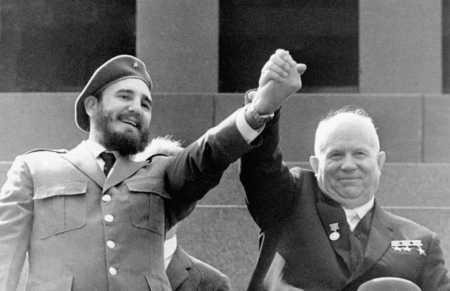
Not allowed into Disneyland: Nikita Khrushchev and Fidel Castro. Photo (c) Associated Press, 1963.
Walt Disney and company leaders were more than happy to comply with the State Department’s agenda. Disneyland officials stated publicly that any foreign guest of the State Department was a welcome guest of Disneyland; on the other hand, Disneyland would deny entry to anyone the State Department decreed should not visit Anaheim. When Soviet Premier Nikita Khrushchev visited the United States in 1959, for example, press records state that he was incensed to learn that he was prohibited from visiting Disneyland due to “security concerns.”[5] Curiously, security concerns never arose at any of Khruschev’s other American visit sites, suggesting the exclusion of Disneyland was perhaps made for other reasons. As historian Emma Lambert has noted, this incident fell in line with overall American security policies of the 1950s. She writes:
Following the Korean War, policy-making attention turned gradually away from Europe and towards other areas of the world that were considered vulnerable to the Soviet threat. The countries identified tended to be in the developing world and in South America. It is, therefore, not surprising to find representatives from exactly those countries being treated to an American tour that included Disneyland. The administration was thus able to use the traditional diplomatic channels of overseas tours to promote relations not with all countries, but with the leaders of selected strategic areas. This manipulation of public relations is made even clearer in the case of Khrushchev’s proposed visit to Disneyland in 1959.[6]
Lambert describes a 1956 Disneyland visit by the “junior ambassadors of the United Nations,” members whose home countries included Argentina, Chile, Mexico, Peru, Venezuela, and Brazil. Selected by the Walt Disney Company through an “intellectual achievement” competition, the countries of origins of these visitors fell in line with the aforementioned national security policy. Within the Cold War context, this youth visit highlighted not only the importance of the United Nations, but the United States’ role within the UN; the importance of youth and family; and overall, the possibilities and promises of democracy.[7] In this way, Disneyland became not only a family vacation destination, but an emblem of what was good about democracy – or conversely, a warning against the evils of communism.
 This cozy relationship with the federal government wasn’t simply for corporate gain; Walt himself strongly believed in the political and social values Disneyland embodied. A generous Republican donor and staunch supporter of Hollywood’s anticommunism efforts, by the 1950s Walt was known as a staunch conservative and “sentimental populist,” a term introduced by historian Steven Watts. In the years following World War II, Watts notes, Walt even more fervently defended the American way of life, turning his studio’s attention to pro-American films that celebrated the best of American values. From Davy Crockett to Pollyanna to the Swiss Family Robinson, post-WWII Disney films hit upon themes of family, self-reliance and a strong work ethic, and the importance of community cohesion. These themes naturally carried over from film to the creation of Disneyland; as Watts shrewdly remarks, “If Disney’s postwar movies presented vignettes of the American Way of Life, Disneyland erected a monument to it.”
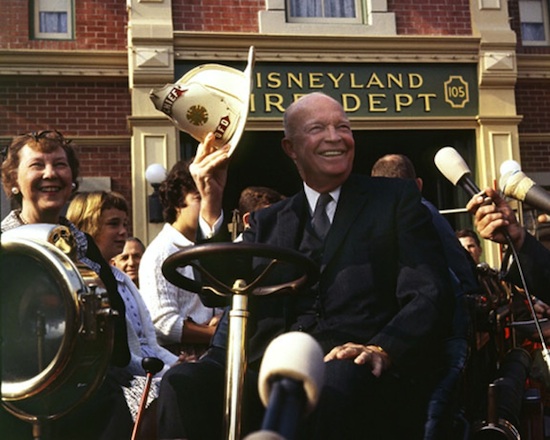
Former president Dwight Eisenhower visits Disneyland. Image (c) Disney Parks Blog.
Ironically, the Walt Disney Company reports that no sitting president has ever visited Disneyland. In spite of this, the role of the Walt Disney Company in political life remains as strong as ever. To date Obama is the sixth sitting president to visit Walt Disney World, following official visits by presidents Nixon (who gave his infamous “I am not a crook” speech from a ballroom at the Contemporary Resort), Carter, Reagan, George H.W. Bush, and George W. Bush. In 2001, when the attacks of September 11th ushered in a new era of Cold War-esque anxieties, President Bush encouraged Americans to “get down to Disney World in Florida. Take your families and enjoy life, the way we want it to be enjoyed.”[8] From the Cold War to the War on Terror to what lies ahead in the unknown, the inherent Americanness of the Disney experience will ensure Disney remains in the political area. Disney never was, and never will be, apolitical.
[1] Steven Watts, The Magic Kingdom: Walt Disney and the American Way of Life. (Columbia, MO: University of Missouri Press, 1997), 396.
[2]Emma Lambert, “Don’t Fight it. You can’t whip Mickey Mouse.” In Containing America, (Birmingham, UK: University of Birmingham Press, 2000), 30.
[3] Leo E. Litwak, “A Fantasy That Paid Off.” New York Times Sunday Magazine 27 June 1965, SM23.
[4] Plaque photograph accessed at http://en.wikipedia.org/wiki/Image:Disneyland_plaque.jpg .
[5] Edith Evans Asbury, “Mme. Khrushchev Regrets Incident.” New York Times. 21 September 1959, 16.
[6] Lambert, 38.
[7] Ibid, 39-40.
[8] George W. Bush, “Remarks by the President to Airline Employees,” 27 September 2001. http://www.whitehouse.gov/news/releases/2001/09/20010927-1.html.
 Nerds in Wonderland
